


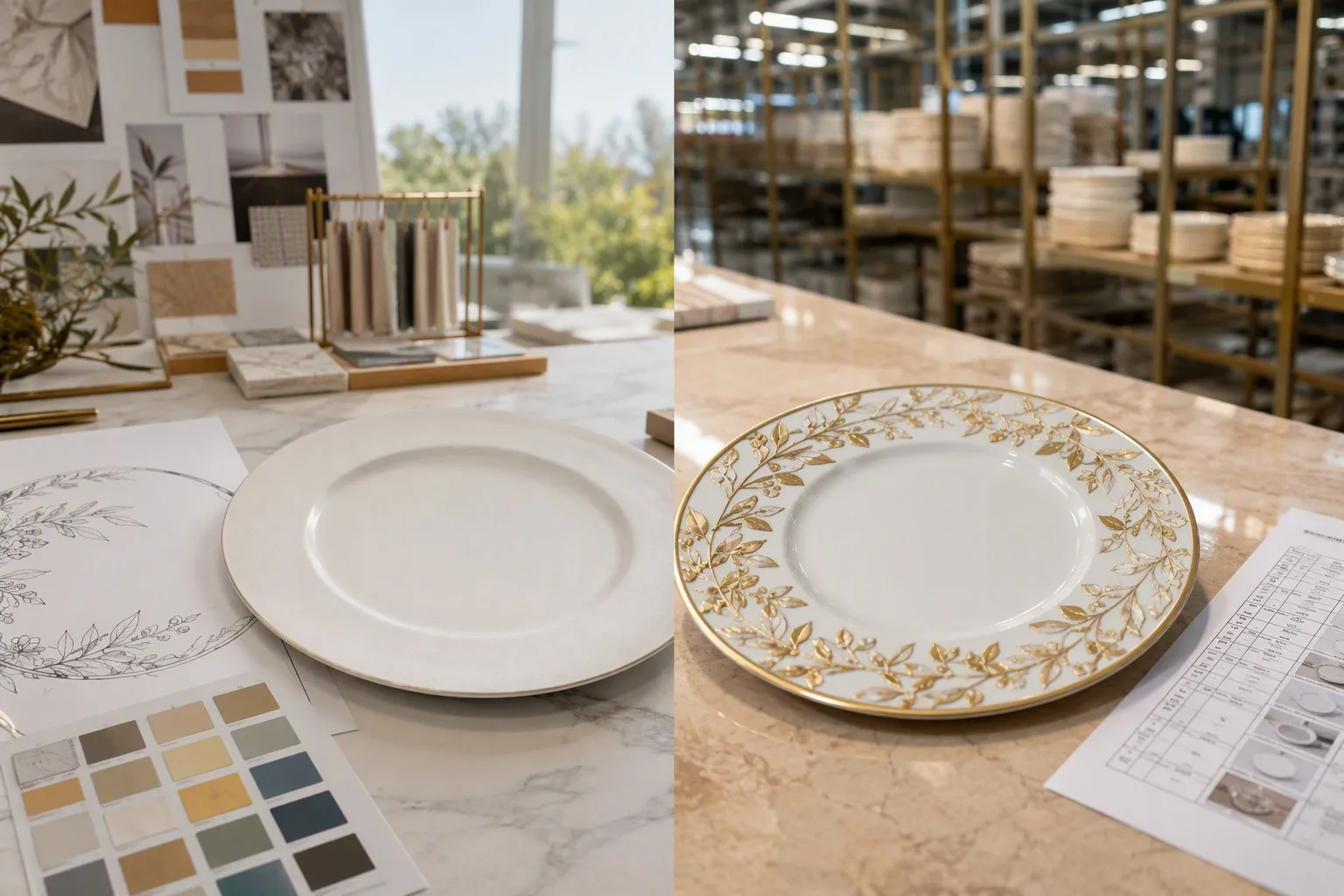
OEM vs ODM: Which Custom Manufacturing Option Is Right for You?
Every home décor brand eventually faces the same question. Should you create your own designs from scratch? Or should you customize existing factory designs with your branding? The answer sits between two manufacturing models: OEM and ODM.
These terms get thrown around casually in sourcing conversations. But confusing them leads to wrong expectations. It leads to missed deadlines and wasted sample fees. Here is what OEM and ODM actually mean for home décor buyers. And here is how to decide which path fits your business.
What OEM Means — and What It Does Not
OEM stands for Original Equipment Manufacturing. In home décor, it means you bring the design. The factory produces it to your exact specifications.
How OEM works in practice:
- You provide the artwork, color references, or a physical sample to replicate.
- The factory produces a free digital mockup within 12 hours of receiving your design files.
- Custom samples ship in 3–5 working days. You approve them before production begins.
- The factory follows your specifications exactly. They match colors by Pantone code and ensure precise pattern placement.
OEM gives you:
- Full creative control over every design element. You own the look from day one.
- Brand differentiation that competitors cannot easily copy. Your designs are yours alone.
- The ability to build a cohesive brand aesthetic across all product categories. Your charger plates match your trays. Your trays match your wall décor.
OEM requires from you:
- Clear design direction. The factory executes your vision. It does not create it for you.
- Time for the sample-and-approval cycle. Custom samples take 3–5 days plus production lead time.
- Confidence in your design choices. If a design does not sell, the inventory is yours — not the factory's.
OEM works best for established brands with a clear visual identity. It also works well for event planners who need themed collections. A wedding planner designing a signature charger plate for their brand is doing OEM.
What ODM Means — and Why It Is Underrated
ODM stands for Original Design Manufacturing. The factory creates the designs. You select from their catalog and add your branding.
How ODM works in practice:
- You browse the factory's existing design library. Many suppliers offer 150+ ready-made charger plate designs.
- You pick designs that fit your brand. You customize them with your logo or packaging.
- The factory produces them using their existing molds, color formulas, and printing setups.
- Lead times are fast. Stock designs ship as quickly as 3–7 working days for orders under 5,000 pieces.
ODM gives you:
- Speed to market. Skip the design phase entirely. Launch a branded collection in under two weeks.
- Lower risk. The factory has already produced these designs. Quality is proven.
- Lower cost. No mold fees or color-matching charges. You use what already works.
- Access to hundreds of new designs released monthly. You can refresh your wall décor and trays without hiring a designer.
ODM requires from you:
- Acceptance that other buyers may carry similar designs. Your brand is in the packaging and positioning.
- A good eye for curation. With 150+ designs, picking winners is a skill in itself.
ODM works best for new brands testing the market. It also works for resellers who prioritize speed and variety over exclusivity. An Amazon seller launching a home décor store with 20 designs in week one is doing ODM.
OEM vs ODM: Side-by-Side Comparison
| Factor | OEM | ODM |
|---|---|---|
| Design ownership | Yours | Factory's (you license for use) |
| Creative control | Complete | Limited to selection and branding |
| Setup time | 3–5 days for custom samples | Immediate — designs exist |
| Lead time | Same as stock (blanks in stock) | 3–7 working days |
| MOQ | 50 pcs/design (same as stock) | 50 pcs/design |
| Unit cost | Same as stock pricing | Same as stock pricing |
| Mold fees | None on standard sizes | None on standard sizes |
| Brand differentiation | High — unique designs | Moderate — branding differentiates |
| Best for | Established brands, planners | New brands, resellers, fast launchers |
| Risk | Higher (unproven designs) | Lower (proven designs) |
A key insight many buyers miss: at factories that keep blanks in stock, OEM and ODM have the exact same MOQ and unit cost. You do not pay more per unit for custom designs. You pay with your time during the sample-and-approval cycle.
The Hybrid Approach: ODM Now, OEM Later
The smartest buyers do not pick one model forever. They use both at different stages.
Stage 1 — Launch with ODM
Start with 10–15 ODM designs across categories. Test the market with low risk. A new brand can launch on Etsy or Amazon with $200–300 in initial inventory. Use charger plates and flower buckets as your foundation.
Stage 2 — Add Your First OEM Designs
After 3–6 months of sales data, identify your top 3–5 sellers. Create OEM versions of those themes with your unique twist. A best-selling botanical charger plate gets a custom color variant. A popular tray design becomes part of a branded collection.
Stage 3 — Build an OEM-Dominant Catalog
As your brand identity solidifies, shift to 70% OEM and 30% ODM. The ODM portion keeps your catalog fresh with new trends. The OEM portion builds a moat competitors cannot cross. This progression lets you grow at your own pace with manageable risk.
Four Questions to Decide OEM vs ODM
Ask yourself these four questions before choosing a path.
1. Do I have clear design direction?
If yes, OEM makes sense. If you are still figuring out what your brand looks like, start with ODM. Browse existing designs and see what resonates with customers. Let data guide your first OEM choices.
2. How fast do I need to launch?
ODM means you can launch this week. OEM adds 3–5 days for custom samples plus your approval time. For Q4 holiday launches, start OEM designs by August. For a next-week launch, ODM is your only practical option.
3. How important is exclusivity to my brand?
If your brand promise is unique designs you cannot find anywhere else, you need OEM. If your promise is curated, affordable home décor with great service, ODM serves you perfectly. Be honest about what your customers actually value.
4. What is my budget for design development?
OEM requires zero additional unit cost at factories that keep blanks in stock. But it does require your time and design input. If you have a designer on your team, OEM costs nothing extra. If you would need to hire one, ODM gives you professional designs at no design cost.
Common Misunderstandings About OEM and ODM
OEM means higher MOQs. Not when the factory keeps blanks in stock. The MOQ is 50 pieces per design for both OEM and ODM charger plates. The production process is the same. Only the design source changes.
ODM means lower quality. Quality depends on the factory's standards. It does not depend on who created the design. A factory running 12 HD UV printers with two rounds of 100% inspection will produce the same quality. It does not matter whether the design came from you or their catalog.
OEM takes months. It can. But it should not. If a factory keeps blanks in stock, OEM lead time equals ODM lead time plus sample approval. That should be 3–7 working days for production plus 3–5 days for custom samples. Total timeline: about two weeks from design to dispatch.
I have to choose one and stick with it. You do not. Most successful home décor brands use both. Their core collection is OEM. Their seasonal and trend-responsive pieces are ODM. This blend gives them brand identity and market responsiveness.
Conclusion: The Right Choice Depends on Your Stage
OEM and ODM are not competing philosophies. They are tools for different stages of your brand's growth. Start with ODM to test the market. Add OEM as you discover what sells. Blend both as you scale. The goal is not purity. It is a profitable, sustainable brand.
At MintiHome, we support both paths. Our 150+ charger plate designs give ODM buyers a deep catalog to curate from. Our in-house design team gives OEM buyers free digital mockups within 12 hours. Same factory-direct pricing. Same 50-piece MOQ. Same 3–7 day lead time. The only difference is whose design goes on the plate.
Ready to start your collection? Choose designs from our trays and wall décor collections. Or send us your custom artwork for a free digital proof. Contact us on WhatsApp (+86 18575541790) or email alanw@mintihome.com for a quote within 12 hours.
Frequently Asked Questions
Does OEM cost more than ODM for charger plates?
At factories that keep blanks in stock, no. The unit cost is the same. The only additional cost is your time during the sample-and-approval cycle. Custom packaging does have a higher MOQ of 3,000 pieces for charger plates. But the charger plates themselves cost exactly the same whether OEM or ODM.
Can I do OEM for some designs and ODM for others in the same order?
Yes. Most factories accept mixed OEM and ODM on a single purchase order. Each design must meet its own MOQ of 50 pieces. But your total order can combine both OEM and ODM designs. Many buyers order 5 ODM designs to test the market. They also add 2 OEM designs to test their own brand ideas.
How do I protect my OEM designs from being sold to other buyers?
Reputable manufacturers do not share custom designs without permission. For full exclusivity, ask about an exclusive design buy-out. This typically requires a single-design order of 1,000 pieces or more. After that, the design is yours and the factory will not offer it to other buyers.
What file formats do I need to provide for OEM designs?
Most factories accept AI, PSD, PDF, or high-resolution PNG/JPG files. Provide Pantone color codes for accurate color matching. If you have a physical sample you want to replicate, send it along. The factory's design team handles the rest. They provide a free digital mockup for your approval.
How long does the OEM design-to-delivery process take end to end?
Digital mockup arrives in 12 hours. Custom samples take 3–5 working days. Production takes 3–7 working days after approval for orders under 5,000 pieces. Shipping depends on method: express courier, air freight, sea freight, or DDP door-to-door. Total timeline from design submission to receiving goods: approximately 2–4 weeks.


